Orchard hazard register template: a free printable register for NZ orchards
A free printable hazard register for NZ orchards, set out the way the regulations describe managing a hazard, with orchard examples to edit or delete.
Last reviewed 5 November 2026. Free to print and use in your own business, no sign-up. Sharing it? Please link to this page.
A starting point, not legal, health and safety or professional advice. You are responsible for checking it fits your workplace. To the extent the law allows, GateBud Limited is not liable for loss from its use.
A hazard register is a simple list of what could hurt someone on your orchard, who it could hurt, and what you do about it. New Zealand law does not use the words "hazard register", but it does require you to identify hazards and manage the risks, and a register is a straightforward way to do that and to show you have.
What you get
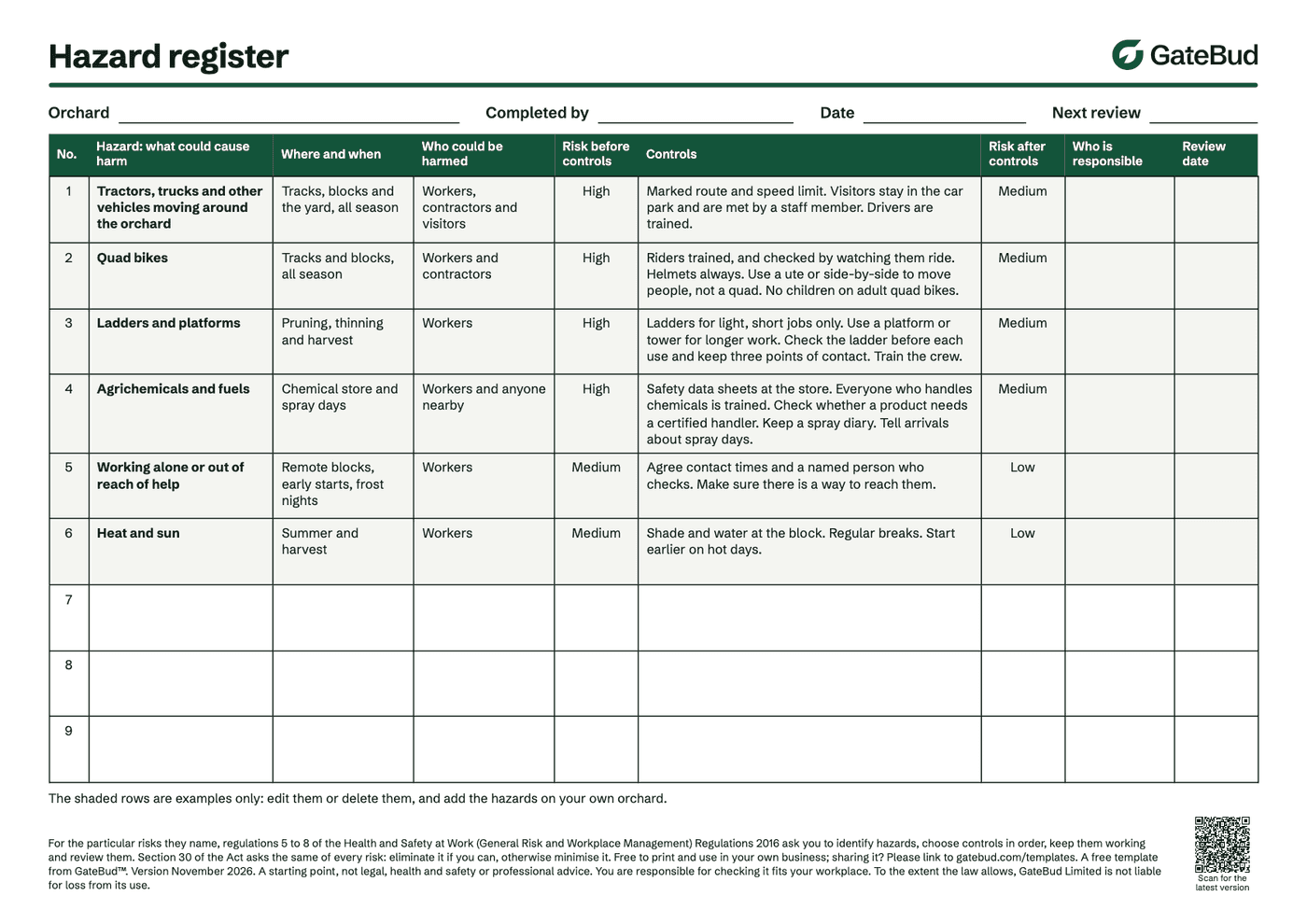
- Page 1, the register. A landscape table with a column for each step: the hazard, where and when, who could be harmed, the risk before controls, the controls, the risk after, who is responsible and the review date. It starts with example orchard rows to edit or delete. Type into it on a computer and save it, or print it and fill it in by hand.
- An Excel version. The same register as a spreadsheet, with drop-down risk ratings, so you can keep adding hazards, sort them and filter them.
- Page 2, more rows and a guide. Extra blank rows, a simple low, medium and high rating guide, and the order to choose controls in.
- Free to print and use in your own business. No sign-up, and nothing to send us. If you are sharing it, please link to this page.
What does the law say about managing hazards?
Section 30 of the Health and Safety at Work Act 2015 says a PCBU must eliminate risks to health and safety so far as is reasonably practicable, and if it cannot, minimise them. The General Risk and Workplace Management Regulations 2016 then set out a process for particular risks, such as remote or isolated work, substances hazardous to health and falling objects:
- Identify the hazards that could give rise to reasonably foreseeable risks (regulation 5).
- Choose controls in order of how effective they are (regulation 6, below).
- Keep the controls working. They must be fit for purpose, suitable for the nature and duration of the work, and installed, set up and used correctly (regulation 7).
- Review them (regulation 8). You must review and, as needed, change a control if it is not controlling the risk, before a change that could create a new or different risk, if a new hazard or risk is identified, and if what workers tell you shows a review is needed. A health and safety representative can also ask for one.
Read it yourself: the regulations on legislation.govt.nz (version as at 10 August 2024).
What changes on 1 April 2027
The Health and Safety at Work Amendment Act 2026 comes into force on 1 April 2027. From then, businesses with fewer than 20 workers mainly have to manage critical risks, and seasonal crews and contractors can count towards that 20. The amendment does not change section 30 or regulations 5 to 8 as described here, so a register is still a sensible way to show how you manage risk. Read what changes for orchards before you decide how detailed yours needs to be.
How to fill it in
- Walk the orchard with the register, and include the sheds, workshop, packhouse, tracks and roads. Take someone who does the work. They know where it nearly went wrong.
- List each hazard. A hazard is something that could cause harm, such as a tractor on a slope, a ladder, a spray or a blind corner.
- Note who could be harmed. Your own team, contractors and visitors can all be at risk.
- Rate the risk before controls as low, medium or high. Use a simple scale you can explain to the crew.
- Write the controls, in the order described below.
- Rate it again after the controls. If it is still high, do more.
- Name who is responsible, and set a review date.
Choosing controls: the order in the Act and regulation 6
Section 30 says to eliminate the risk if you can. Where that is not reasonably practicable, regulation 6 says to work down the rest of this list, and to move to the next step only if the risk remains:
- Eliminate the hazard if you can, for example by not doing the job at all.
- Substitute, isolate or engineer. Swap the hazard for something less risky, keep people away from it, or add a physical control such as a guard.
- Use administrative controls. A method of work, procedure, sign or instruction that reduces the risk.
- Provide personal protective equipment, for any risk that still remains.
Orchard hazards to think about
These are prompts, not a full list. Your orchard will have hazards that are not here. The example rows in the PDF draw on WorkSafe's guidance on quad bikes, ladders and farm chemicals (linked below), so check them against your own orchard.
- Moving vehicles: tractors, quad bikes, trucks, forklifts and bins on the move
- Working at height: ladders, platforms and pruning towers
- Agrichemicals, fuels and other substances hazardous to health
- Machinery, including power take-off shafts and guards
- Heat, sun and cold
- Heavy lifting and repeated handling of bins and boxes
- Uneven, wet or slippery ground
- Electrical hazards such as overhead lines and irrigation pumps
- Working alone or out of reach of help
- Visitors and contractors moving through the property
Visitors and contractors
Some hazards only matter to people who do not know the orchard, such as the blind corner, the spray block or the overhead line. Tell arrivals about them before they start. A sign at the gate does not tell you who read it. If you use GateBud™, you write the hazards into a site document that visitors read as part of checking in, and the record shows which version each person acknowledged. How the document library works.
Keep it alive
A register on the wall that nobody updates does not help anyone. Review a control when it is not working, before a change that could create a new risk, and when a new hazard shows up. Also put a regular review date on the register so it gets a look even when nothing seems to have changed.
Before you rely on this template
The register is a starting point and the examples are only examples. Your own hazards, your people and your property decide what belongs in it. It is general information, not legal advice. WorkSafe New Zealand is the regulator and is the place to ask about your own situation.
Sources
- New Zealand Legislation, Health and Safety at Work (General Risk and Workplace Management) Regulations 2016 (version as at 10 August 2024), regulations 5 to 8 and 21, checked on 5 November 2026. The one amendment waiting to take effect, the Health and Safety at Work Amendment Act 2026, changes regulations 9, 15 and 19 and not these.
- New Zealand Legislation, Health and Safety at Work Act 2015, section 30.
- WorkSafe New Zealand, Safe use of quad bikes (fact sheet), Safe working with ladders and stepladders and Certified handlers, read on 5 November 2026.
- GateBud, The document library.