Orchard emergency evacuation plan template: a free printable plan and roll-call sheet
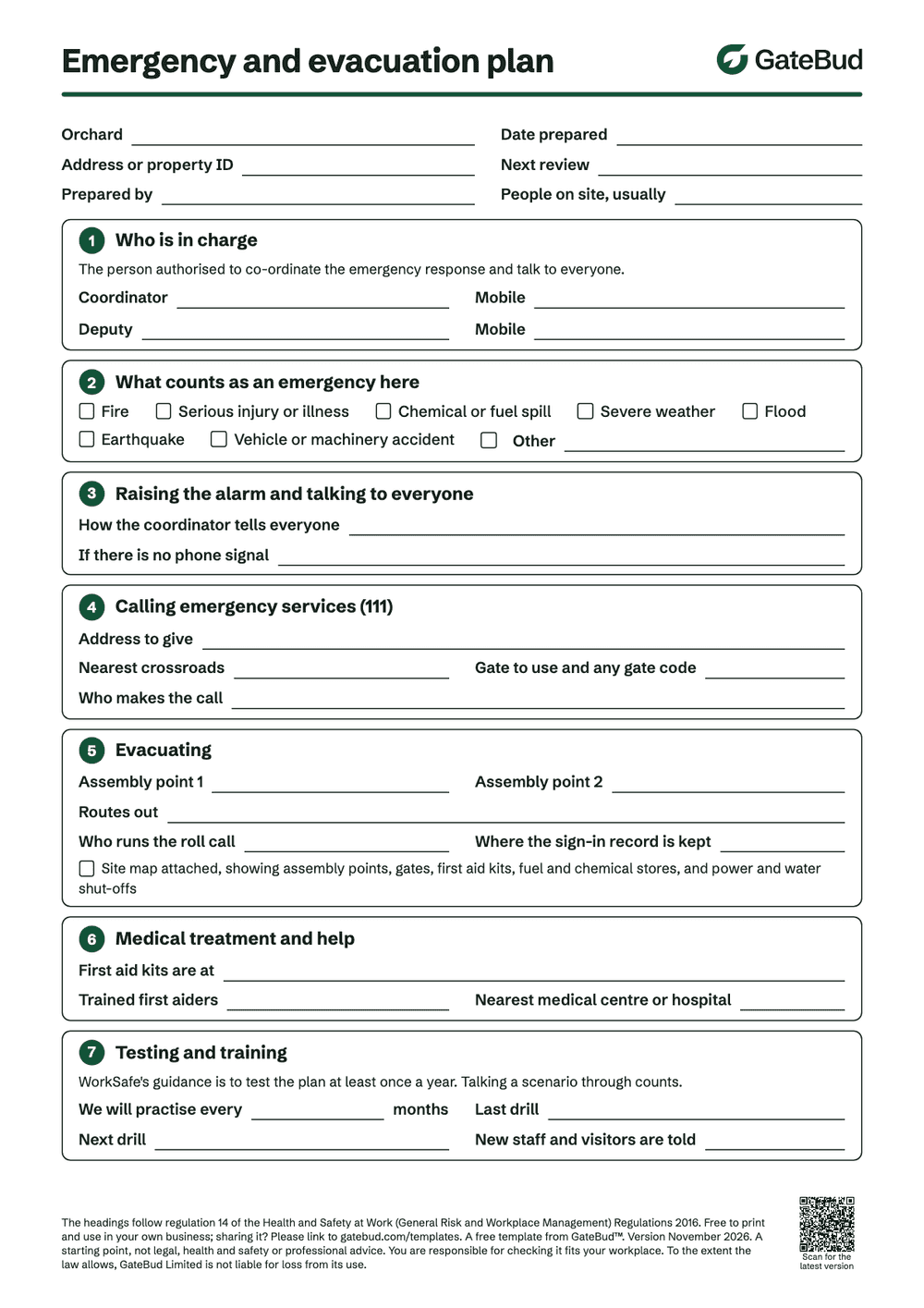
A free two-page PDF for NZ orchards: an emergency plan laid out under the headings regulation 14 asks for, and a roll-call sheet for the assembly point.
Last reviewed 5 November 2026. Free to print and use in your own business, no sign-up. Sharing it? Please link to this page.
A starting point, not legal, health and safety or professional advice. You are responsible for checking it fits your workplace. To the extent the law allows, GateBud Limited is not liable for loss from its use.
Under New Zealand health and safety law, the person or business in charge of a workplace must make sure an emergency plan is prepared for it, and an orchard is no exception. This template gives you the headings the rule asks for, ready to fill in, plus a one-page roll-call sheet to take to the assembly point.
What you get
- Page 1, the plan. A section for each thing the regulation says an emergency plan must cover, with space for your own names, numbers and places. Type into it on a computer and save it, or print it and fill it in by hand.
- Page 2, the roll-call sheet. Room for each name, whether the person is staff, a contractor or a visitor, their arrival time and a tick, plus space to record who ran the roll call and when everyone was accounted for.
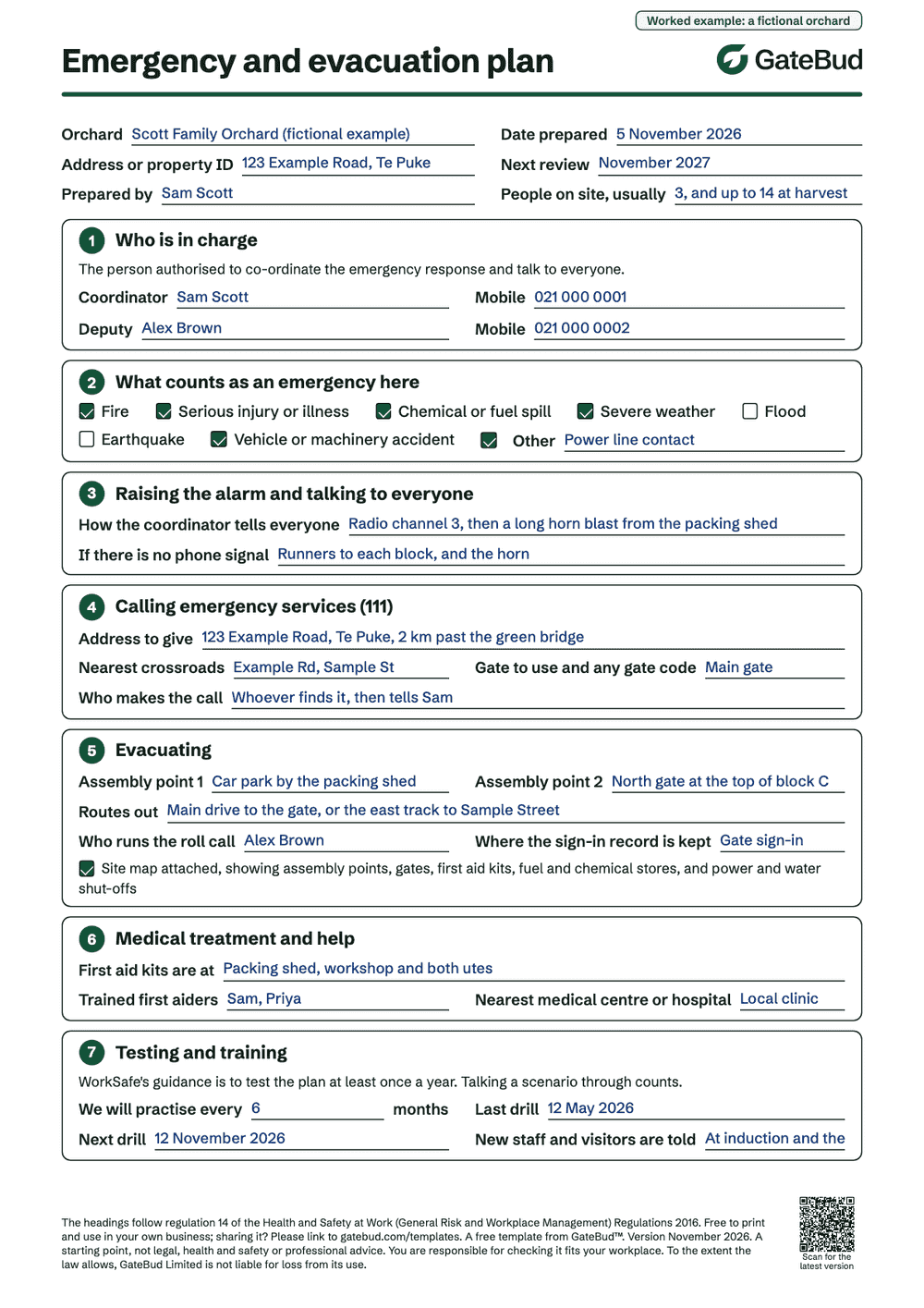
- A worked example. The same two pages filled in for a fictional orchard, so you can see what a finished plan looks like.
- Free to print and use in your own business. No sign-up, and nothing to send us. If you are sharing it, please link to this page.
What must an emergency plan include?
The rule is regulation 14 of the Health and Safety at Work (General Risk and Workplace Management) Regulations 2016. In summary, the PCBU, the business or undertaking in charge of the work, must make sure an emergency plan is prepared for the workplace. The plan must:
- set out emergency procedures, including an effective response to an emergency, evacuation procedures, procedures for notifying emergency services at the earliest opportunity, medical treatment and assistance procedures, and procedures for effective communication between the person authorised to co-ordinate the emergency response and everyone else at the workplace
- provide for testing the procedures, including how often
- provide for information, training and instruction for relevant workers on carrying out the procedures
You must also keep the plan up to date so it stays effective, and put it into action if an emergency happens. The regulation says to take into account the kind of work, the hazards, the size and location of the workplace, and the number and make-up of the workforce.
You can read it yourself: regulation 14 on legislation.govt.nz (version as at 10 August 2024).
How to fill it in
- Walk the property with the plan in your hand. Note your gates, sheds, fuel and chemical stores, power lines and the ways in and out.
- Name who is in charge. Write down the person who will co-ordinate an emergency and a deputy, with mobile numbers that work on the orchard.
- Write the address emergency services need. Include the rural address, the nearest crossroads, which gate to use and any gate code, so anyone can read it out on a 111 call.
- Choose an assembly point, or two. A second point means the emergency itself cannot block your only one. Put up a sign.
- Decide how to raise the alarm. Radio, phone call, horn or siren. Phone signal can be patchy on an orchard, so do not rely on a single way.
- List your first aid kits and trained first aiders, and the nearest medical centre or hospital.
- Draw a simple site map showing the assembly points, gates, first aid kits, fuel and chemical stores, and the power and water shut-offs. WorkSafe's guidance says a plan should show where emergency equipment, first aid supplies and utilities are.
- Set how often you will practise, and write down the date of each drill.
- Talk it through with your team. You must engage with your workers when you make decisions about the plan, and when you change it in a way that affects their health or safety. Then tell your contractors too, and anyone who turns up after the briefing.
See it filled in
Here is the plan completed for a fictional orchard, Scott Family Orchard. Every name, road and number in it is invented. Use the worked example button at the top of this page to download it, both pages, with the roll-call sheet from a practice drill.
Include visitors and contractors in the roll call
A roll call only works if you know who is on the orchard. Your own team is easy. Visitors, contractors and pickers who come and go are the gap. Keep a record of everyone who arrives and leaves, on paper at the gate or in a system, and bring it to the assembly point with the roll-call sheet.
A paper sign-in book has to be kept up to date, and someone has to carry it to the assembly point. If you use GateBud™, the record lives on a phone instead: visitors and contractors scan a QR code to check in and out, and the Evacuation page lists everyone currently recorded as checked in, ready for a warden to read out and tick off at the assembly point. It supports your emergency plan, it does not replace it, and anyone who has not checked in will not be on the list, so keep a paper fallback. How the Evacuation roll call works.
Practise it
- WorkSafe's guidance is to test an emergency plan at least once a year. Testing can be as simple as picking a scenario, such as a fire or an earthquake, and working it through the plan, or you can stage a drill.
- Time how long it takes to account for everyone, and write down what went wrong. Ask your team what they thought.
- Fix the plan, then set the date of the next drill before you put it away.
- Look at the plan again whenever something changes, such as a new access road, a new crew, a change of people with emergency jobs or a new hazard.
Before you rely on this template
This template follows the headings in regulation 14 and the points in WorkSafe's fact sheet on workplace emergency plans. WorkSafe says a plan should be tailored to the work and the workplace, and that for low-risk work it need not be long or complicated. Your plan has to fit your own property, your own hazards and the people who work there, so treat the template as a starting point. It is general information, not legal advice. WorkSafe New Zealand is the regulator and is the place to ask about your own situation.
Sources
- New Zealand Legislation, Health and Safety at Work (General Risk and Workplace Management) Regulations 2016 (version as at 10 August 2024), regulation 14, checked on 5 November 2026. The one amendment waiting to take effect, the Health and Safety at Work Amendment Act 2026, changes regulations 9, 15 and 19 and not this one.
- WorkSafe New Zealand, Workplace emergency plans (fact sheet), read on 5 November 2026.
- GateBud, Evacuation and the roll call.